
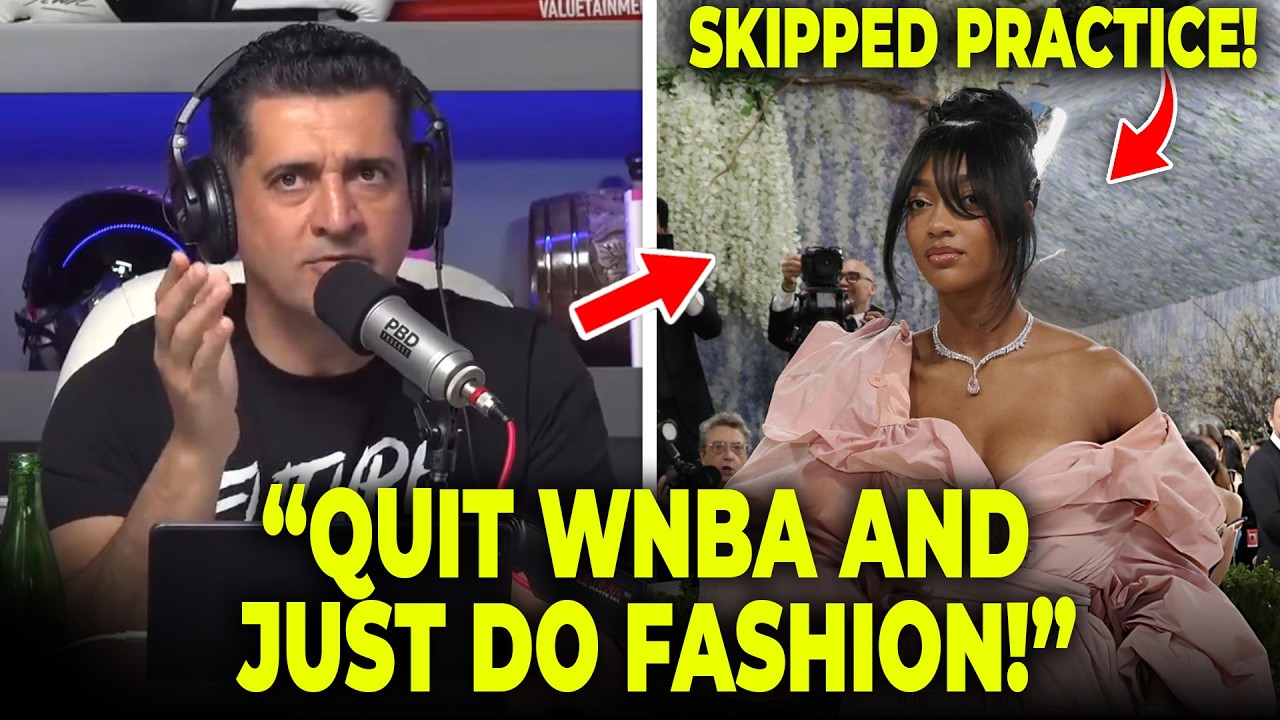
In the rapidly evolving landscape of professional women’s basketball, a stark and uncompromising divide has emerged between social media brand reach and actual, measurable economic impact. The 2026 WNBA season arrived alongside a historic new collective bargaining agreement (CBA), fundamentally rewriting the financial reality for its athletes. Yet, as players navigate their brand-new tax brackets, a fierce debate has ignited over who truly holds the leverage in growing the sport. Financial commentator and entrepreneur Patrick Bet-David recently took to his platform to deliver a viral, numbers-driven reality check that systematically dismantled recent player ultimatums, targeting forward Angel Reese in the process.
The controversy kicked off when Reese went live on social media, floating the dramatic possibility of WNBA players executing a coordinated work stoppage or “sitting out” if their demands regarding salaries and benefits were not met under the new contract framework. Reese, who has been highly vocal about her rookie salary failing to cover her basic cost of living in major cities, argued that the players held the power to disrupt the system.
Bet-David, however, countered her argument not with personal vitriol, but with cold, unyielding corporate economics. He reminded viewers that historically, the WNBA has operated at an approximate loss of $40 million per year—a financial deficit entirely subsidized by the NBA and its owners who write annual checks to keep the women’s league afloat.
“Sit out from what exactly?” Bet-David asked, highlighting a fundamental flaw in Reese’s negotiation strategy. In the history of professional sports strikes—such as the massive MLB work stoppage of 1994 or the NFL and NBA labor disputes—players successfully withheld their labor because the leagues were generating multi-billion-dollar profit margins that panicked owners desperately wanted to protect. A strike within an enterprise that is already bleeding millions of dollars in operating costs doesn’t frighten ownership; it simply exposes a massive bluff.
The core of Bet-David’s argument rests on market reality: a strike or an ultimatum only works when the specific labor you are withholding is the exact engine driving the revenue. And when analyzing the data behind the WNBA’s explosive new growth, the financial trail leads directly to one individual: Caitlin Clark.
During her seismic rookie season, Clark didn’t just break on-court records; she single-handedly transformed the commercial viability of the entire league. With Clark driving the narrative, the WNBA witnessed an unprecedented 48% spike in live attendance, drawing over 2.3 million fans through arena turnstiles, alongside a jaw-dropping 170% explosion in TV viewership on networks like ESPN. Television executives publicly credited the “Caitlin Clark Effect” as the sole justification for signing a monumental 11-year, $2.2 billion media rights agreement averaging $200 million annually—a figure that would have been laughed out of corporate boardrooms just twenty-four months prior.
It is this multi-billion-dollar media injection that funded the massive salary increases across the entire 2026 CBA. Under the new agreement, Clark’s base salary rightfully scaled past $500,000, with immediate eligibility for a supermax contract next season that could push her annual earnings above $1.3 million. Because of the revenue Clark generated, her peers—including those who spent the previous year openly critiquing or resenting her historic spotlight—received massive raises. Reliable two-way stars like Aaliyah Boston signed lucrative extensions, while elite scorers like Kelsey Mitchell, Lexi Hull, and Sophie Cunningham saw their contracts swell significantly.
In stark contrast, the market priced Angel Reese’s value at approximately $300,000 under the new CBA—a figure that places her well below the league’s newly established average salary of $530,000. While Reese boasts a massive social media following, a high-profile signature shoe deal with Reebok, and a glamorous calendar filled with high-fashion runway appearances, the hard corporate data shows that her off-court brand activity simply does not translate into primary television viewership or secondary market ticket demand in the way sponsors track.
This financial valuation became even more glaring as the 2026 preseason tipped off. Recently traded from the Chicago Sky to the Atlanta Dream for late first-round draft assets, Reese had a prime opportunity to silence critics and prove she spent her off-season strictly inside a gymnasium. Instead, her highly scrutinized debut against her former team on April 29th mirrored the exact same developmental plateaus that plagued her rookie year. Playing against a heavily depleted Chicago roster that rested its top stars, Reese turned in an inefficient 2-for-7 shooting performance from the field in just 13 minutes before promptly fouling out of the game.
:max_bytes(150000):strip_icc():focal(749x0:751x2)/caitlin-clark-angel-reese-tout-052025-968b60bafa13483d83f773e1530b52d4.jpg)
Basketball analysts noted that Reese’s game has very few places to hide; because she does not possess a reliable perimeter jump shot, her entire offensive value relies heavily on finishing cleanly at the rim. When that inside finishing fails, her box score completely stalls out. The situation grew even more concerning on May 3rd, when the Washington Mystics’ young center, Kiki Iriafen, completely neutralized Reese in the paint, altering and blocking her shots with routine ease. Getting decisively outmatched around the rim by a young player whom casual fans have barely searched on Google presents a massive red flag for a player expecting superstar-level compensation.
The 2026 WNBA salary sheet ultimately acts as a definitive corporate verdict on market value. The current ecosystem heavily rewards tangible audience growth and basketball execution over social media metrics and lifestyle branding. Caitlin Clark earned her massive financial windfall by converting casual television viewers into dedicated, nightly consumers who schedule their lives around WNBA tip-off times. Meanwhile, Angel Reese’s current $300,000 contract serves as a direct message from the market: social media influence can secure external fashion invitations, but only elite, unselfish basketball execution inside the gym will bridge the massive 4-to-1 salary gap at the professional level.


