
In the world of elite sports, the transition from one generation to the next is rarely smooth. It is often messy, emotional, and fraught with debate. But for USA Basketball, a program steeped in a tradition of loyalty and continuity, a new and provocative voice is challenging the status quo with a level of ruthlessness that has fans and analysts reeling. A viral roster projection has emerged, one that ignores sentimentality in favor of cold, hard performance metrics, proposing a “New Era” for Team USA that sees legends cut, rookies crowned, and the entire philosophy of the program rewritten.

The “Point Gawd” Dethroned: The Chelsea Gray Controversy
Perhaps the most shocking aspect of this proposed overhaul is the exclusion of Chelsea Gray. Known as the “Point Gawd,” Gray has been a cornerstone of American basketball, a WNBA Finals MVP, and a player whose clutch performances are the stuff of legend. For years, her spot on the roster was considered untouchable—a reward for her high basketball IQ and her “institutional knowledge” of the international game.
However, the new analysis argues that “institutional knowledge” can no longer mask the undeniable effects of time and injury. Gray, who battled foot and leg injuries throughout the 2024 season, is being scrutinized not for what she did, but for what she is right now. The argument is blunt: in a league now dominated by speed and athleticism, Gray’s production has dipped. She is no longer a “top-five guard,” and in the eyes of this new vision, holding onto her blocks the path for younger, more dynamic playmakers. It is a harsh assessment of a player who has given so much, but it underscores a growing sentiment that Team USA cannot afford to be a retirement home for aging stars, regardless of their résumé.
The Griner Dilemma: Versatility Over Size
Equally controversial is the proposed cutting of Brittney Griner. Standing 6’9″, Griner has been the ultimate cheat code for Team USA for over a decade, providing a size advantage that few international teams could match. But the game is changing. The modern international style is faster, reliant on perimeter shooting and defensive versatility—areas where a traditional post player like Griner, now in her 30s, struggles to keep up.
The proposed replacement? Cameron Brink. Despite suffering an ACL injury in her rookie season, Brink represents the prototype of the modern big: mobile, capable of protecting the rim, switching onto guards, and stretching the floor. The choice to select Brink over Griner is a declaration that the future matters more than the past. It is a gamble on potential and “modern versatility” over the safety of established dominance, signaling a shift away from “grinding it out in the paint” to a high-octane, pace-and-space offense.
Vindication for Caitlin Clark
At the heart of this roster revolution is, inevitably, Caitlin Clark. The decision to leave her off the 2024 Paris Olympics team was met with widespread backlash, described by many as a “massive controversy” with “terrible optics.” This new proposal corrects that perceived error with emphasis, installing Clark not just as a member of the team, but as the starting point guard.
The statistical argument is overwhelming. Averaging 19.2 points and leading the league with 8.4 assists per game as a rookie, Clark is the engine that drives this new vision. The proposal envisions a backcourt that is terrifying in its offensive potential: Clark paired with Jackie Young, whose two-way dominance and championship pedigree make her the perfect complement. This duo, supported by the likes of Paige Bueckers and Kelsey Plum, creates a guard rotation that is virtually unguardable. As the commentary suggests, “You don’t need no more guards after those four.”
The Angel Reese Reality Check
The inclusion of Angel Reese in this projected squad comes with a caveat that is as refreshing as it is brutal. The analysis strips away the hype and focuses on fit. Reese is not asked to be a scorer or a focal point—roles she often attempts to fill with the Chicago Sky due to team necessity. Instead, her role on Team USA is defined with razor-sharp precision: “Rebound and play defense. That’s it.”
This “tough love” approach highlights a key aspect of roster construction. On a team featuring Clark, Bueckers, and Young, there are plenty of people to shoot the ball. The team needs someone to do the dirty work, to grab the boards, and to bring the energy. By accepting this limited but crucial role, Reese fits into the puzzle perfectly. It is a stark reminder that on a “Superteam,” sacrifice is the price of admission.
A Philosophical Shift: 2028 and Beyond
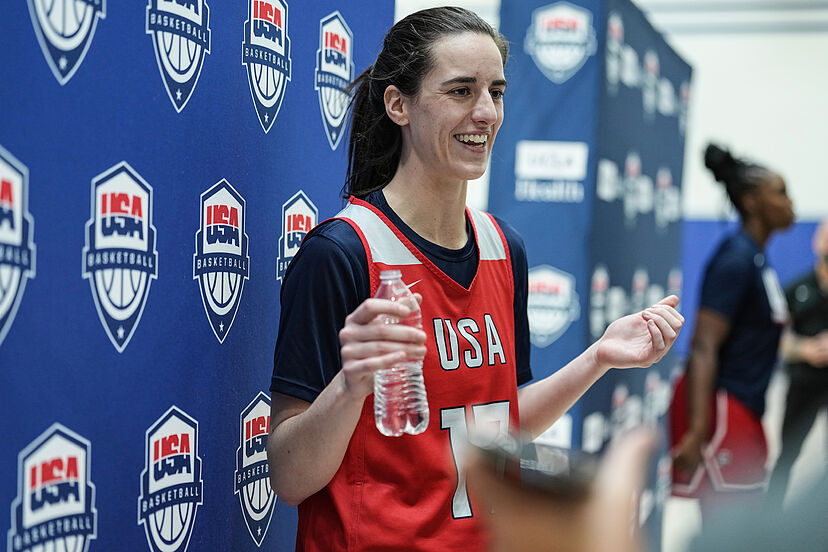
What this viral roster proposal truly represents is a fundamental philosophical shift for USA Basketball. Historically, the program has valued “continuity”—keeping veterans like Diana Taurasi and Sue Bird for as long as possible to ensure stability. This conservative approach won gold medals, but it also nearly cost them in Paris, where teams like France and Australia pushed the U.S. to the brink.
The gap is closing. The world is getting better, faster, and more skilled. The argument presented is that the U.S. can no longer rely on reputation and “old heads” to intimidate opponents. To maintain dominance leading into the 2028 Los Angeles Olympics, the team must mirror the evolution of the game itself.
This means prioritizing the “funner,” faster team. It means embracing the 3-point revolution fully. It means acknowledging that while Chelsea Gray and Brittney Griner are legends, their time has passed. The future belongs to the likes of Clark, Brink, Bueckers, and Young.
This proposed roster is more than just a list of names; it is a manifesto for the future of American women’s basketball. It is a call to be ruthless in the pursuit of excellence, even if it breaks the hearts of those who built the foundation. The message is clear: The torch hasn’t just been passed; it’s been snatched away.


