
Do you need to increase the fertility of your soil? Here we show you how to get a natural fertilizer that can protect and fertilize the roses in your garden.

Anyone who has a garden knows how extraordinary roses can be from an aesthetic point of view, but also very fragile. In fact, it is not always easy to make your rose bush flowering and lush. If the flower does not bloom completely, it is possible that the soil is not really suitable for growing roses.
If this is the case, it is very likely that the soil is not draining optimally or that it is not receiving the right amount of sunlight.
In addition, among all plants, roses are the ones that need the most fertilizer . Therefore, to facilitate flowering as much as possible, it is appropriate to introduce plenty of fertilizer into the soil. This compound serves to make roses flower optimally thanks to the presence of potassium , phosphorus and nitrogen .
These three ingredients are essential to achieve a perfect “explosion” of your rose bush. The flowers will be born without problems and the roots and leaves will be completely healthy.
In this article we will let you discover the powerful natural fertilizer that can make your rose bush thrive and grow strong in the garden . Here you will find everything you need to know about it.
Do you want an explosion of roses in the garden? Here is the best natural fertilizer
Fertilizers are available on the market in some specialized stores. They have variable costs but are essential for your garden and especially for your roses. However, in this article we will show you an ideal solution to avoid going to your trusted shop. What? Here are the details.

As we expected, we are going to talk about a very powerful natural fertilizer thanks to a specific ingredient . This way you can always be safe when growing your roses. Before finding out which product we are referring to, we will indicate the best time to apply fertilizer .
It cannot be applied at any time during the season. In fact, if you choose the wrong month, you will be doing something absolutely harmful to your roses. The fertilizer must be introduced into the soil for the first time with the arrival of spring – approximately between March and April.
Two more applications of fertilizer must be made in the summer months between June and July, approximately 30 days apart. You never have to postpone these dates. Applying fertilizer in August or September is disadvantageous, as roses are already preparing for winter dormancy.
Are you ready to find the best natural fertilizer for your roses? Here you will find everything you need to know about it and the best method to put into practice . Let’s analyze everything together.
The effective natural method
Some food waste can be very effective in flowering various plants and fertilizing. This is also the case with banana peels and some other pieces of this fruit. Around the bushes you need to dig a few inches of soil and place the skins in the ground before re-establishing the ground cover.
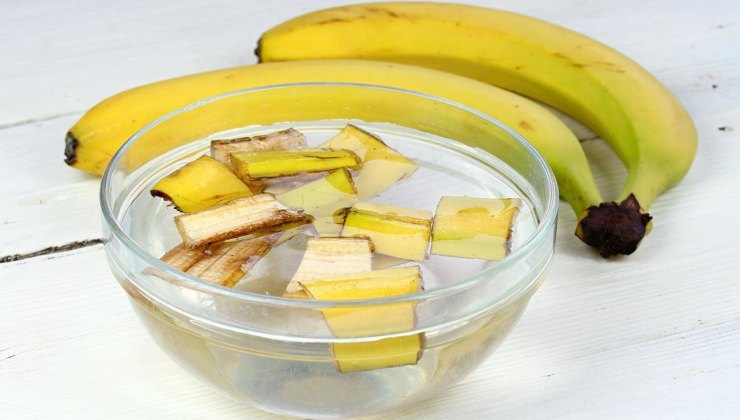
However, this is not the only method you can use with bananas as a natural fertilizer. In the process we are going to describe, it is necessary to use two very ripe bananas , whose peel is almost completely blackened.
It is advisable to cut the bananas into small pieces with the peel . At the same time, you need to boil about 5 liters of water in a large pot to evaporate the chlorine. When the water has boiled, add all the previously cut ripe banana pieces to the pot. Then let everything boil for about 10 minutes.
The water has reached a fairly dark color . Let everything cool down and then add another 10 liters of “clean” water, also free of chlorine.
The water boiled with bananas must be added to the container with the other 10 liters of water , using a sieve to filter everything and prevent the banana pieces from ending up in the solution.
At this point, you can pour about half a liter of this solution for each plant . The roses will grow strong and healthy and will best absorb this powerful and effective natural fertilizer, which consists of water soaked in the nutrients of ripe bananas.


